
New Employees
Building confidence, connection and capability from day one.
Starting your journey at UCalgary
Beginning a new role is one of the most important transitions in your career. At UCalgary, your learning and development happen in many ways: through the work you do, the people around you, structured learning and the resources you access.
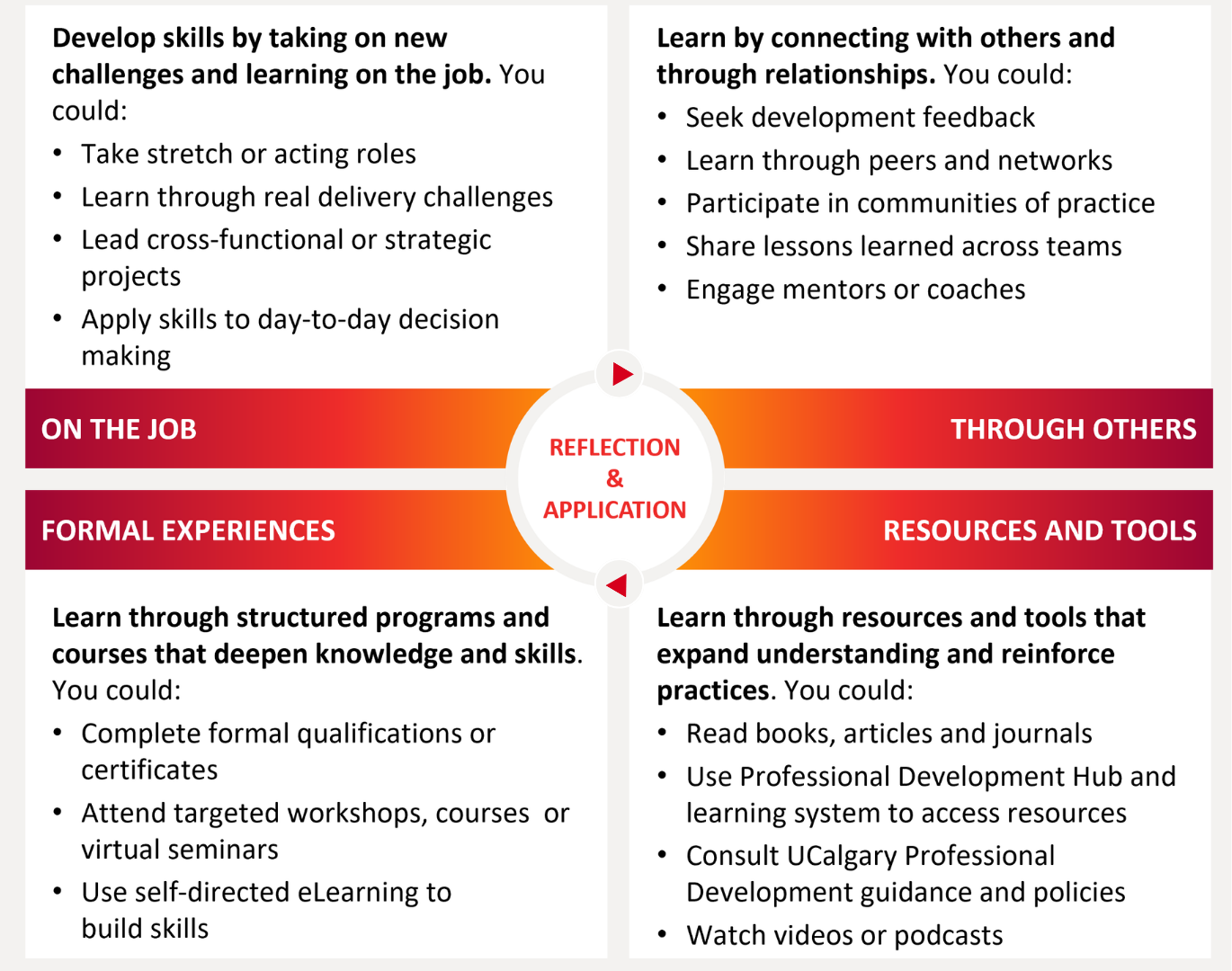
The UCalgary Continuous Learning Model highlights four complementary ways of learning: In Your Role, Through Others, Formal Experiences, and Resources & Tools, with Reflection & Application at the core.
This journey helps you:
- Focus on what matters most in your first months
- Build confidence through your day-to-day work
- Form meaningful connections across the university
- Access programs, tools and resources to support your success
How do I get started and grow as a new employee?
Learning happens through your experiences, relationships, structured programs and self-directed resources. Start with what you need most right now and revisit this journey as you build confidence and capability over time.

Build confidence through your day-to-day work
- Get clear on expectations early and seek feedback along the way
- Actively engage in your onboarding and early responsibilities
- Ask questions to build understanding of systems, processes, and expectations
- Connect what you are learning to your role and team priorities
In your new role, learning by doing is one of the most important ways to build capability and confidence.
- Trying to absorb too much at once. Focus on what’s most relevant now
- Hesitating to ask for clarity or support
- Overlooking opportunities to learn through everyday tasks
- Complete onboarding tasks and required training
- Learn systems and processes by doing
- Seek clarification and feedback regularly
- Observe how work gets done across your team
- What did I learn today that helped me better understand my role?
- What still feels unclear?
- What’s one thing I can apply tomorrow?
- Provide clear expectations and priorities
- Encourage questions and normalize learning
- Offer timely, practical feedback
- Celebrate progress

Build connection, belonging, and perspective
- Being clear on what you want to learn - Go into conversations with a purpose (e.g., how to approach a task, not just what to do).
- Asking thoughtful, specific questions - Focus on understanding how others think and decide, not just getting quick answers.
- Learning from a range of people - Seek input from peers, more experienced colleagues, and different teams to broaden perspective.
- Being open to feedback and different views - Be willing to hear things that challenge your current approach; that’s where growth happens.
Testing and applying what you hear - Try ideas in your own work soon after; learning sticks if you use it.
- Limiting your network to only immediate colleagues
- Focusing only on tasks, not relationships
- Avoiding opportunities to participate or connect
- Not seeking feedback or input
- Attend welcome and orientation sessions
- Connect with colleagues and peers
- Learn from your leader and team members
- Participate in community and culture-building experiences
- Who have I connected with this week?
- What did I learn from someone else’s perspective?
- Where could I expand my network?
- Foster connection and inclusion within the team
- Encourage participation in learning and community opportunities
- Provide opportunities for collaboration and feedback

Build foundational knowledge through structured learning
- Structured programs provide frameworks, shared understandings, and foundational skills
- Builds confidence and capability over time
- Meet and engage with others outside of your team
- Taking courses without linking them to your role
- Trying to do too much too quickly
- Relying only on formal learning
- Enrol in courses and programs aligned to your goals
- Participate in cohort-based learning
- Build foundational professional or technical skills
- What key idea stood out to me?
- How can I apply this in my role?
- What do I want to learn next?
- Help prioritize relevant learning opportunities
- Support time for learning and development
- Encourage application of new skills
-
Required Training
- Environment, Health & Safety Training (mandatory)
- Cybersecurity, Privacy & Research Security Training (mandatory)
-
Welcome & Getting Started
-
Workplace Culture & Inclusion
- Self-Leadership (Workshop)
- Enhancing a Culture of Respect in the Workplace (Workshop)
- Communication (LinkedIn Course)
- Getting Things Done (LinkedIn Learning)
- Problem-Solving Techniques (LinkedIn Learning)
Indigenous Perspectives & Reconciliation
- Beginning the Journey Towards Reconciliation (Online Course)
- The Story of ii’ taa’poh’to’p (Online Course)
- UCalgary Culture & Indigenous Strategy (Webpage)
-
Leadership Development
- Emerging Leaders Programs (Continuing Education)
- ULead: Foundations (for new/emerging leaders)
- ULead: Engagement (for experienced leaders)
More opportunities for leaders: Leaders (Webpage)
-
Teaching & Academic Development
- Taylor Institute for Teaching and Learning
For more learning opportunities for Postdoctoral Associate (Webpage), Faculty and Academic Staff (Webpage)

Learn in the flow of work
- Accessible anytime to support immediate needs
- Enables just-in-time, self-directed learning
- Supports ongoing growth alongside your work
- Search for quick answers and guidance
- Build skills through short, targeted learning and application
- Revisit tools as your needs evolve
- What resource helped me most this week?
- What do I need to learn next?
- Where can I find support when I need it?
- Promote use of available tools and resources
- Encourage ongoing, self-directed learning
- Share relevant resources with team members
LinkedIn Learning
- Log in to UCalgary’s LinkedIn Learning using single sign‑on.
- Optionally connect your LinkedIn profile to receive personalized recommendations and display completed courses by selecting Me > Settings > Connect LinkedIn (LinkedIn login required).
- Set your learning preferences by choosing topics like business, creative or technology skills.
- Once set up, explore recommended courses, search by topic, and start learning anytime, anywhere.
- Log In Here
-
Development and Career Planning Tools
-
Learning and Tuition Support
-
LinkedIn Learning
- Log in to UCalgary’s LinkedIn Learning using single sign‑on.
- Optionally connect your LinkedIn profile to receive personalized recommendations and display completed courses by selecting Me > Settings > Connect LinkedIn (LinkedIn login required).
- Set your learning preferences by choosing topics like business, creative or technology skills.
- Once set up, explore recommended courses, search by topic, and start learning anytime, anywhere.

Upcoming Learning Opportunities
View upcoming learning experiences to help enhance your professional development and connect with colleagues across campus.