
Leaders
Learning and practising leadership in ways that help teams thrive.
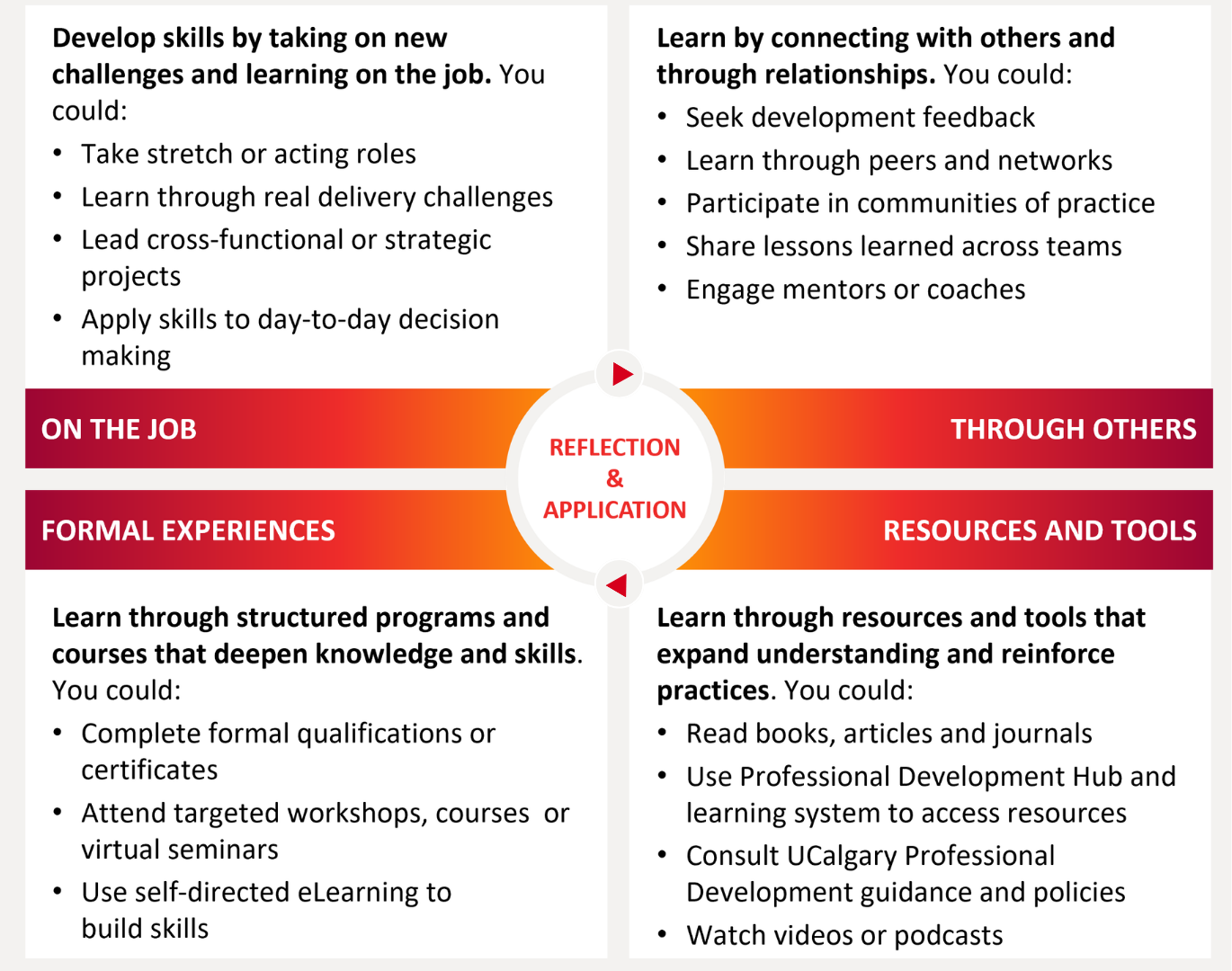
Continuous Learning Model
As a Leader, your development happens in two connected ways:
through how you grow your own leadership capability and through how you enable the growth of others.
Leadership learning is not separate from the work. It is built through everyday decisions, conversations and responsibilities. How you shape work, create space for learning, and support reflection has a direct impact on team confidence, capability and wellbeing.
The UCalgary Continuous Learning Model recognises that leadership development happens in four complementary ways: In Your Role, Through Others, Formal Experiences, and Resources & Tools and with Personal Reflection and Application at the core.
Your Individual Development Plan (IDP) helps you take ownership of your growth as a leader, document progress and have focused development conversations. Used well, it also supports meaningful discussions about how you are developing others.
This journey helps you to:
- Strengthen your sound leadership judgement and confidence
- Learn through real leadership work
- Develop others intentionally and equitably
- Choose formal learning with purpose
- Reflect on leadership growth over time using your IDP
How do I develop as a Leader?
Learning happens in different ways: through your work, your relationships, structured programs and on‑demand resources. Start by choosing the approach that best fits your current goals.

Develop leadership capability through everyday leadership work
Leadership capability is built most effectively through real leadership responsibility, supported by reflection and feedback.
Learning in your role works best when:
- You are developing sound judgement, prioritization, confidence and influence
- Your leadership role is evolving or expanding in scope
- You are navigating ambiguity, prioritisation, or competing demands
- Learning happens alongside ongoing responsibilities
- Expectations or decision‑making authority are unclear
- During periods of rapid change or transition
- During challenging interactions
Leadership growth slows when people are pushed too far without enough support.
-
Light lift (low risk, easy to integrate)
- Assign ownership of a recurring decision instead of reviewing or approving it
- Shift work from “execute” to “design and recommend,” with clear guardrails
- Rotate facilitation of a standing meeting or agenda item over a defined period
-
Medium lift (visible growth, requires active leader support)
- Lead a pilot, change initiative, or process improvement
- Work through ambiguity independently, with coaching rather than escalation
- Co-lead a project with a peer from another team or function
-
High lift (significant growth, requires intentional workload rebalancing)
- Step into acting or interim leadership roles
- Lead cross-functional or institution-wide initiatives
- Own work with unclear solutions or competing priorities
After periods of stretch, ask:
- What leadership judgement did I practise here?
- What felt more complex than expected?
- What would I do differently next time?
- How did my actions affect others’ confidence or clarity?
Leaders enable in your role learning by intentionally designing work for development, not just delivery.
Effective support includes:
- Matching stretch to readiness to ensure challenge is meaningful but achievable
- Clarifying expectations, outcomes, and decision boundaries to enable confident ownership
- Rebalancing or deprioritizing other work during periods of stretch to make space for learning
- Checking in on cognitive load and progress and not just outcomes to prevent overload and support growth
- Providing timely feedback and opportunities for reflection to reinforce learning and course-correct

Strengthen leadership through relationships and shared insight
Learning through others extends leadership capability by drawing on experience, perspective, and judgement beyond your own.
This approach works best when:
- You are navigating unfamiliar, ambiguous, or high‑stakes situations
- You want to learn how to approach an issue, not just what to do
- Leadership confidence or role identity is still developing
- Decisions benefit from multiple perspectives
Use this approach with care when:
- Connections lack a clear learning purpose
- Conversations stay at the surface level
- Insight is not reflected on or applied
-
Light lift (low risk, easy to integrate)
- Encourage observation of meetings or decision‑making forums
- Normalize asking peers for advice and perspective
- Create space for cross‑team learning conversations
-
Medium lift (visible growth, feedback helpful)
- Sponsor mentoring relationships with clear learning focus
- Support and participate in communities of practice around shared opportunities
- Pair staff across units for short‑term collaboration
-
High lift (significant growth, clear boundaries required)
- Co‑lead initiatives with other leaders
- Mentor others as a way to refine your own leadership approach
- Represent your unit in broader institutional work
After learning through others, consider:
- What did I notice about how others exercised sound judgement?
- Which assumptions of mine were challenged?
- What approach will I test next?
Leaders enable learning through others by:
- Encouraging mentoring and peer consultation
- Creating access to diverse perspectives and networks
- Normalizing feedback and reflection
Mentorship & Connection
- Finding a Mentor at UCalgary (Document)
- Mentoring at UCalgary (Document)
- UCalgary Alumni Mentorship (MentorLINC)
- Being a Good Mentor (LinkedIn Learning)
- Building a Mentorship Plan (LinkedIn Learning)

Build leadership skill through structured learning
Formal learning provides structure, shared language, and foundational leadership capability, especially when paired with application.
Formal learning works best when:
- Learning aligns clearly to current or future leadership responsibilities
- New skills are applied soon after learning
- Reflection is built into the learning cycle
- Courses are taken without a clear purpose
- Learning is completed but not applied
- Capacity does not allow for follow‑through
Light lift (low risk, easy to sustain)
- Short workshops or online modules tied to immediate needs
Medium lift (visible growth, some leader support needed)
- Multi‑session programmes and cohort‑based learning
- Conferences with clear application intent
High lift (significant growth, rebalance workload)
- Certificates or advanced leadership programmes
- Extended cohort or academic programmes
After formal learning, ask:
- What leadership capability am I building?
- Where will this show up in my work?
- What will I apply or change first?
Leaders strengthen formal learning by:
- Clarifying development priorities
- Supporting realistic timelines
- Creating space to apply learning
- Encouraging sharing of insight with others
Development happens through application and not solely attendance.
-
Leadership Skills
- ULead: Engagement (ULearn)
- The Art of Giving and Receiving Feedback (ULearn)
- Develop Your Skills as a New Manager (LinkedIn Learning)
- Becoming a Manager Professional Certificate (LinkedIn Learning)
- Leadership and Coaching (University of Calgary Continuing Education)
- Strategic Decision-Making for Leaders ( University of Calgary Continuing Education)
- MBA Programs ( Haskayne School of Business)
-
Inclusive Leadership & People Practices
- Equitable and Inclusive Hiring for Managers (Workshop)
- Equitable and Inclusive Hiring for Academic Selection (Workshop)
- Fostering a Culture of Respect through Leadership (Workshop)
- The Art of Giving and Receiving Feedback (Workshop)
- Certificate in Professional Management (Continuing Education)
-
Workplace & Labour Relations
- The Working Mind for Managers (Workshop)
- Introduction to Managing a Unionized Environment (Online Course)

Support leadership practice with tools and on‑demand resources
Resources support leadership learning when they are used in the flow of work, not after decisions are made.
Learning through tools works best when:
- Resources support real leadership decisions
- Tools reduce uncertainty or cognitive load
- New processes or expectations need reinforcement
Use this approach with care when:
- Resources are collected but not used
- Relying too much on tools instead of sound judgment
- Reading is overtakes application
Light lift (low risk, easy to integrate)
- Use guides, templates, or policies during people decisions
- Reference tools during meetings and decisions
Medium lift (visible growth, feedback helpful)
- Integrate tools into workflows
- Ask teams to share what worked or didn’t
High lift (significant growth, clear boundaries required)
- Co‑create or redesign tools based on real use
- Embed tools and resources in enterprise systems where possible
After using a resource, ask:
- How did this tool support my decision‑making?
- How will I know if it’s actually useful?
- What stands out as most useful or different from how I currently work?
Leaders support learning through tools by:
- Modelling use of resources themselves
- Making tools visible and accessible
- Encouraging application over consumption
- Reinforcing judgment over rigid use
- Leader Guide to Development Conversations (University of Calgary)
- Artificial Intelligence (University of Calgary)
- Writing Courses
- Governance and leadership (University of Calgary)
- Professional Development Hub Resources Library (University of Calgary)
- Haskayne School of Business Executive and Professional Development (University of Calgary)
- HR Partners (University of Calgary)

Upcoming Learning Opportunities
View upcoming learning experiences to help enhance your professional development and connect with colleagues across campus.