
Individual Development Plan
Take an active role in your learning and growth
What is an Individual Development Plan?
The Individual Development Plan (IDP) is a practical tool to help employees reflect on their goals, identify development priorities, and plan meaningful learning experiences. Your IDP is a living document that evolves as your role, interests, and priorities change over time. It supports ongoing development conversations between employees and leaders and helps connect day-to-day work with longer-term growth.
An effective IDP considers not only the skills you want to build, but also how your growth contributes to your team, community, and the impact you want to make at UCalgary. Development happens through experience, relationships, reflection, and learning from diverse perspectives.

Individual Development Plan (IDP)
Reflect on Your Impact
As you complete your IDP, consider how your learning and growth contribute to your team, community, and the broader impact you want to make at UCalgary.
- How does my development contribute to my team?
- How does my development support reconciliation?
- How does my work contribute to sustainable impact?
- Whose perspectives, experiences, or ways of knowing could help broaden my understanding?
An Individual Development Plan (IDP) helps you:
- Reflect on your strengths, interests, and career goals
- Identify development priorities connected to your current role and future aspirations
- Plan practical learning experiences through work, relationships, and formal learning
- Track progress and adjust goals over time
- Support meaningful development conversations with your leader
IDPs are most effective when they are simple, focused, and revisited regularly.
What an IDP is and is not
- A flexible and evolving development tool
- Focused on growth, learning and capability building
- Employee-led, with support from leaders
- Connected to real work and practical experiences
- Intended to guide ongoing development conversations
- A performance evaluation
- A guarantee of promotion or future roles
- A one-time exercise
- A checklist of training courses
Using an IDP demonstrates a commitment to continuous learning and development.
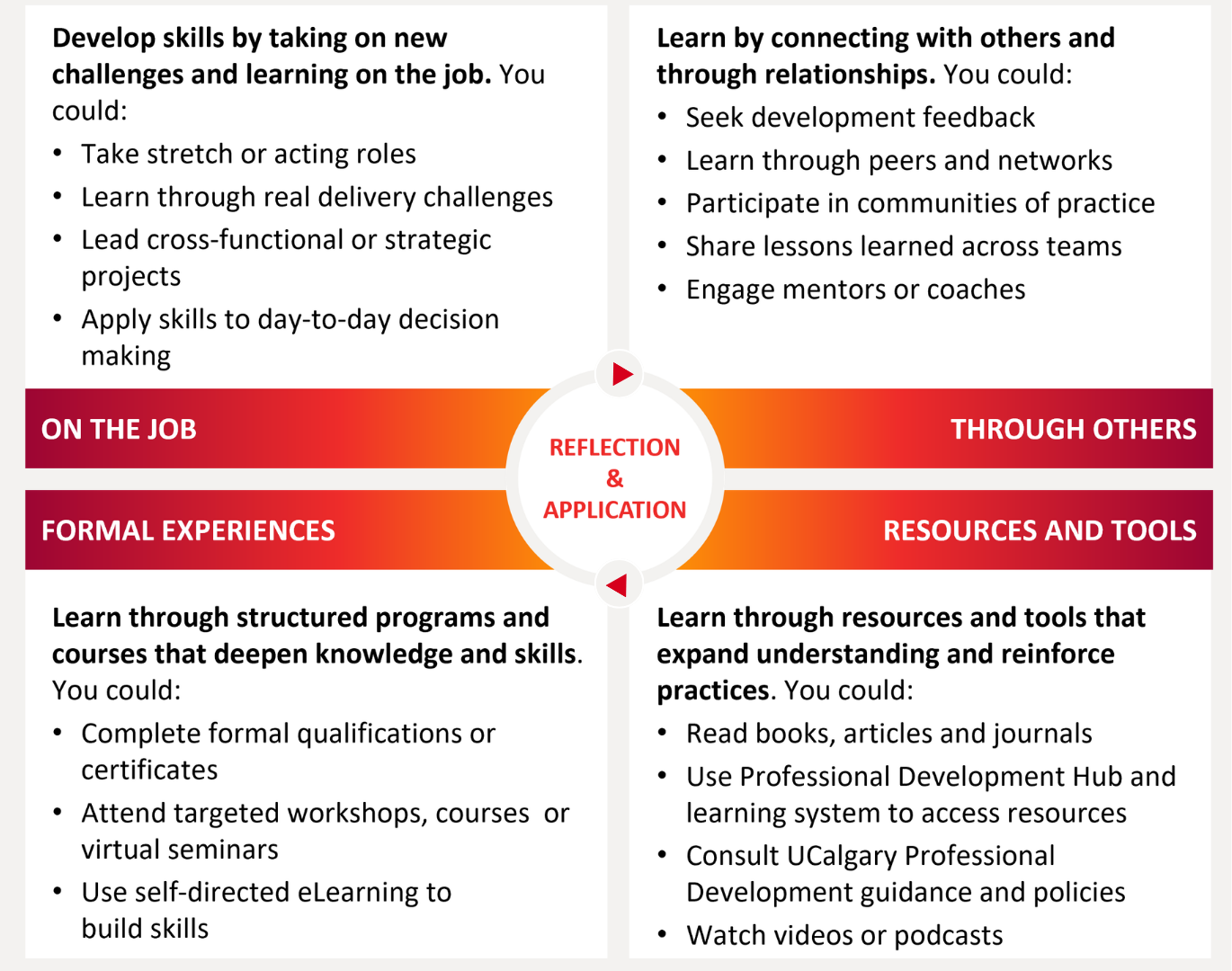
The IDP and Continuous Learning Model
The IDP is designed to support development through your work, your relationships, structured programs and on‑demand resources. Start by choosing the approach that best fits your current goals.
Learn through experience, examples include:
- Stretch assignments
- Project work
- Acting opportunities
- Cross-functional collaboration
- New responsibilities
Connect with your UCalgary community, examples include:
- Mentoring
- Coaching
- Job shadowing
- Peer learning
- Communities of practice
Learn through structured opportunities, examples include:
- Courses and workshops
- Conferences and webinars
- Certificate programs
- University learning programs
- LinkedIn Learning
Learn through tools and information, examples include:
- Articles and research
- Templates and guides
- Toolkits and systems
- Professional resources
Balanced development plans typically include a mix of experiential, relational, and formal learning.

Why use an IDP?
An Individual Development Plan (IDP) helps create structure around these practices by encouraging intentional, ongoing development through practical learning experiences connected to current work, future goals, and continuous growth. It invites reflection on how your learning supports your team, broadens your perspectives, and contributes to the university's commitment to reconciliation, inclusion, sustainability, and community impact.
How employees can use the IDP
Reflect on Your Growth
Consider your strengths, interests and goals. Think about the skills, experiences, or opportunities that would support your growth now and in the future.
Choose Development Priorities
Focus on 1–2 meaningful development priorities that will have the greatest impact on your growth over the next 6–12 months.
Plan Learning Actions
Identify practical learning experiences through work, relationships, formal learning, or resources that connect to your development priorities.
Discuss and Revisit Your IDP
Use your IDP to support conversations with your leader, gather feedback and revisit your plan every 3–4 months as priorities evolve.
How leaders can support employee development
Leaders play an important role in creating conditions for learning and growth. Effective leader support includes:
Download the Leader Guide to Development Conversations. This guide helps leaders lead high-quality development conversations using the Individual Development Plan (IDP). Download Resource
Tips for meaningful development conversations
- Ongoing rather than once a year
- Future-focused and strengths-based
- Grounded in real work and practical application
- Focused on growth and learning rather than evaluation
- Shared conversations with active participation from both employee and leader
- Quarterly check-ins
- Career conversations
- Goal planning discussions
- Changes in role or responsibilities
- Following major projects or learning experiences

IDPs and performance documents
Employees may choose to upload their Individual Development Plan (IDP) as supporting documentation within their PeopleSoft performance document. Step-by-step instructions for employees and managers are available in the Complete Annual Assessment reference guides, including how to upload and review supporting documents. Uploading an IDP is intended to support development conversations and documentation. The IDP itself is not a performance evaluation or assessment tool.
Frequently asked questions
The IDP is owned and maintained by the employee. Leaders support the process through discussion, feedback and development opportunities.
Review and update your IDP every 3–4 months or whenever priorities, goals or responsibilities change.
No. The IDP should be flexible and useful. Focus on the sections and priorities most relevant to your current development goals.
The IDP can support development discussions connected to performance conversations, but it is not a performance evaluation tool.
No. The IDP supports growth and development planning but does not guarantee future roles or advancement opportunities.
Download a summary of the Individual Development Plan (IDP) overview to support reflection, planning, and development conversations. Designed for both employees and leaders, this resource makes it easy to revisit and apply your growth goals anytime. Download Resource