
Academic Staff
Enrich your teaching and research, and build a meaningful, sustainable academic career.
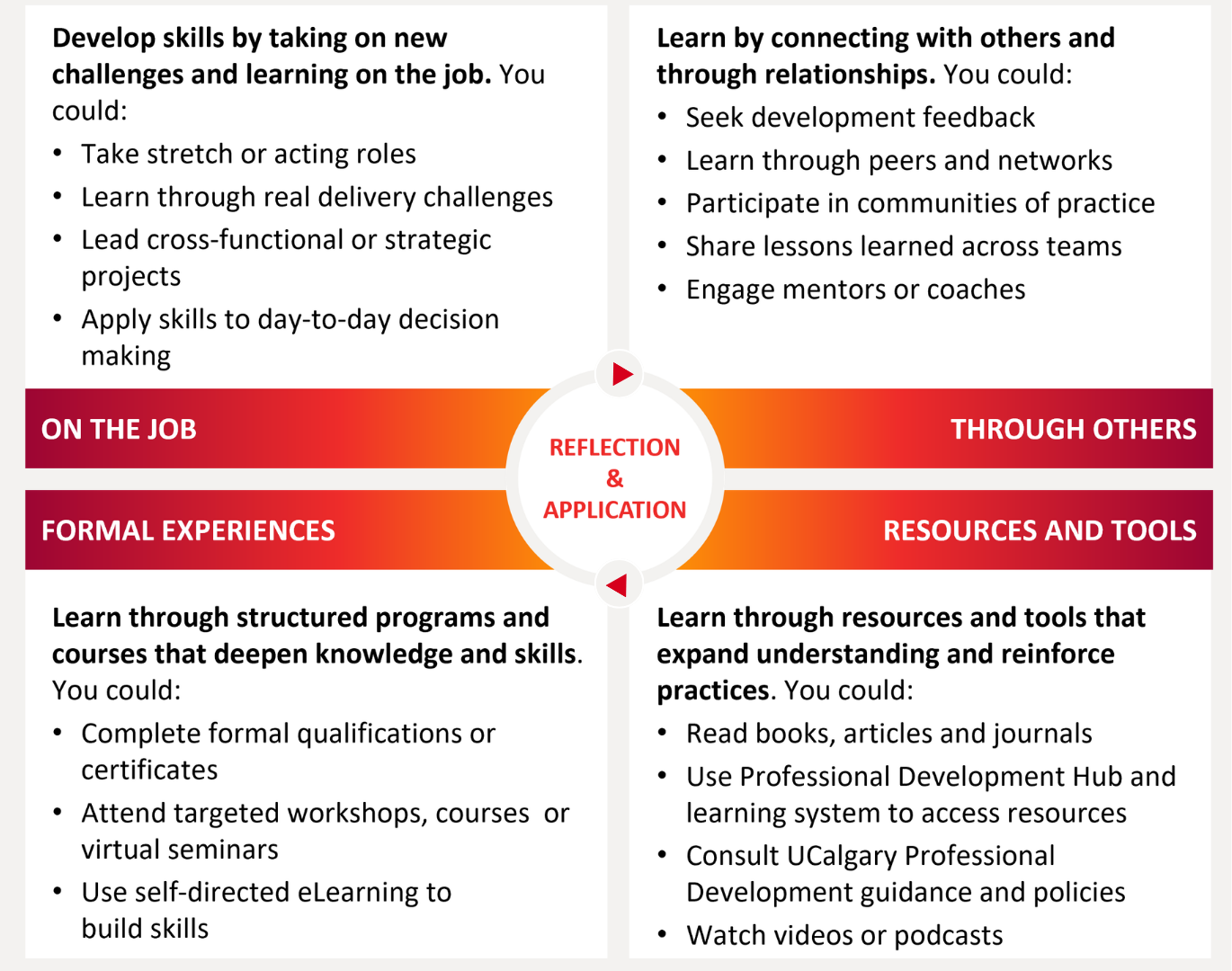
Continuous Learning Model
As Academic Staff, your learning is shaped by the responsibilities you carry, the questions you explore and the academic communities you engage with over time. Growth does not happen separately from your teaching, research and service, it happens through them.
The UCalgary Continuous Learning Model recognizes that leadership development happens in four complementary ways: In Your Role, Through Others, Formal Experiences, and Resources & Tools and with Personal Reflection and Application at the core.. This reflects how academic capability is built: through experience, dialogue, intentional learning and thoughtful use of resources.
Your Individual Development Plan (IDP) can be used to capture priorities, reflect on growth and support meaningful conversations about your development. It is a flexible and not a performance evaluation.
This journey helps you to:
- Decide where to focus your development at different career stages
- Use teaching, research, and service as opportunities for learning
- Learn from academic communities and colleagues
- Select formal learning that strengthens practice and impact
- Reflect on growth and document it over time using your IDP
How do you want to develop right now?
Learning happens in different ways: through your work, your relationships, structured programs and on‑demand resources. Start by choosing the approach that best fits your current goals.

Build capability through the work academic staff do every day
- You are aiming to strengthen professional sound judgement and decision‑making confidence
- Your academic, professional, or leadership role is evolving or expanding in scope
- You are preparing for additional responsibility, such as program leadership, committee chairing, or broader institutional service
- Learning needs to occur alongside continuing academic and professional responsibilities, rather than through separate programs
- Workload is already unsustainably high
- Expectations, accountabilities, or decision‑making authority are unclear or shifting
- There is limited opportunity for reflection, dialogue, or feedback
-
Light lift (low risk, easy to sustain)
- Assume responsibility for a recurring decision rather than seeking approval each time
- Lead a meeting, agenda item, or discussion for a defined period
- Represent the unit or department in a cross‑functional or cross‑faculty working group
- Shift from primarily executing tasks to developing and presenting options or recommendations
-
Medium lift (visible growth, some leader support needed)
- Lead a pilot or improvement initiative
- Take responsibility for a new collaboration group
- Co‑lead work with a peer from another unit
- Work through uncertainty before escalating, reflecting on what was attempted and why
-
High lift (significant growth, rebalance workload)
- Acting or interim appointments
- Cross‑faculty or institutional initiatives
- Leading work where direction, outcomes, or pathways are not yet fully defined
- What challenged me most?
- What assumptions did I test or change?
- What would I do differently next time?
- How does this shape how I approach my role now?
Leaders support learning through work by intentionally shaping responsibility.
Effective support includes:
- Matching stretch to readiness rather than assigning the biggest opportunity
- Being clear about expectations, authority, and decision boundaries
- De‑prioritizing or delaying other work during periods of stretch
- Checking in on cognitive load and confidence and not just outcomes
- Small, regular reflection (even five minutes) helps experience turn into learning.

Learn and grow through academic relationships and communities
Learning through others is most effective when academic relationships are used intentionally for insight and sound judgement, not simply for connection.
Learning through others works best when:
- You are navigating new, ambiguous, or high‑stakes academic or institutional situations
- You want to understand how to approach a challenge, not only what action to take
- Academic confidence, leadership presence, or role identity is still developing
- Decisions would benefit from perspectives beyond your immediate role, unit, or discipline
Use this approach with care when:
- Connections lack a clear learning purpose
- Learning remains conversational without application
- Engagement depends solely on informal access or familiarity
Learning through others becomes development when insight is reflected on and applied.
-
Light lift (low risk, easy to sustain)
- Ask peers how they approached complex academic or professional decisions
- Observe meetings or discussions outside your usual context
- Compare how different colleagues respond to similar challenges
-
Medium lift (visible growth, some leader support needed)
- Participate in mentoring relationships with clear learning intent
- Join communities of practice related to current teaching, research, or leadership challenges
- Seek feedback from multiple academic perspectives
-
High lift (significant growth, rebalance workload)
- Co‑lead initiatives or committees
- Mentor colleagues as a way to articulate and refine your own thinking
- Represent your unit or discipline in broader academic or institutional initiatives
After learning through others, pause to consider:
- What insight did I gain about how to approach this work?
- Which assumptions were challenged or reinforced?
- How will I apply this perspective in my academic practice?
- What would I do differently next time?
Leaders support learning through others by making connection purposeful, not incidental.
Effective support includes:
- Encouraging mentoring, peer consultation, and communities of practice
- Connecting people across roles, disciplines, or units when perspective matters
- Normalising help‑seeking and learning through dialogue
- Encouraging reflection after conversations, not just connection itself
Equitable leadership means being intentional about who gains access to networks, introductions, and high‑value academic spaces.

Build knowledge and skills through structured academic learning
Formal learning is most effective when it strengthens academic practice and is intentionally connected to real work.
Formal learning works best when:
- Shared academic or professional language is needed
- Complex concepts benefit from guided instruction or scholarly grounding
- Credentials or formal study strengthen credibility or effectiveness
Use this approach with care when:
- Formal learning is undertaken without a clear purpose
- Learning is not applied soon after participation
- Time and capacity do not allow for meaningful engagement
Formal learning alone does not change practice; application and reflection do.
-
Light lift (low risk, easy to integrate)
- Attend targeted workshops or short learning sessions aligned to current work
-
Medium lift (visible growth, feedback helpful)
- Participate in structured learning pathways or certificates
- Attend conferences with a clear plan for application or sharing
-
High lift (significant growth, clear boundaries required)
- Complete extended programs, credentials, or academic courses
- Engage in cohort‑based leadership academies or formal study
After formal learning, consider:
- What concepts or approaches resonate most with my practice?
- What should I adapt, test, or discontinue?
- How does this learning influence my teaching, research, or service?
Leaders strengthen formal learning by connecting it back to real academic work.
Effective support includes:
- Helping clarify why a course or program is timely
- Creating space to apply learning soon after participation
- Encouraging reflection on what should change and what should not
- Valuing learning outcomes, not just attendance or credentials
Development happens through application, not completion.
- Taylor Institute for Teaching and Learning
- Academic Leadership Academy
- UCalgary Continuing Education
- New Academic Welcome

Strengthen academic practice with on‑demand resources and support
Resources and tools are most effective when they support learning at the point of need.
Learning through resources works best when:
- Tools support real teaching, research, or service tasks
- Resources reduce uncertainty or cognitive load
- Learning is applied immediately and reflected on
Use this approach with care when:
- Resources are collected but rarely used
- Too many tools create confusion
- Reading replaces application
Light lift (low risk, easy to integrate)
- Use guides, templates, or policies while completing work
Medium lift (visible growth, feedback helpful)
- Apply the same resource across contexts and reflect on outcomes
High lift (significant growth, clear boundaries required)
- Contribute to improving shared academic resources
- Curate tools or guides for colleagues
After using a resource, consider:
- How did this resource shape my decision‑making?
- Where did it help and where did it fall short?
- What would I do differently next time?
Leaders support resource‑based learning by normalising use and modelling it themselves.
Effective support includes:
- Pointing people to trusted resources
- Encouraging just‑in‑time learning
- Reinforcing that looking things up is part of good academic practice
- Ensuring resources are visible, current, and usable
Quick access:
- UCalgary Library
- Research Services
- Find and Manage Funding
- Community of Practice for Early-Career Teaching-Stream Faculty Members
- University Policies and Procedures
Faculty Specific resources:
- Cumming School of Medicine
The Office of Faculty Development supports growth, connection, and academic practice. - Faculty of Social Work
Professional development opportunities to enhance practice in mental health and human services.

Upcoming Learning Opportunities
View upcoming learning experiences to help enhance your professional development and connect with colleagues across campus.