
Postdoctoral Scholars
Support your research, teaching and professional growth during your postdoctoral appointment.
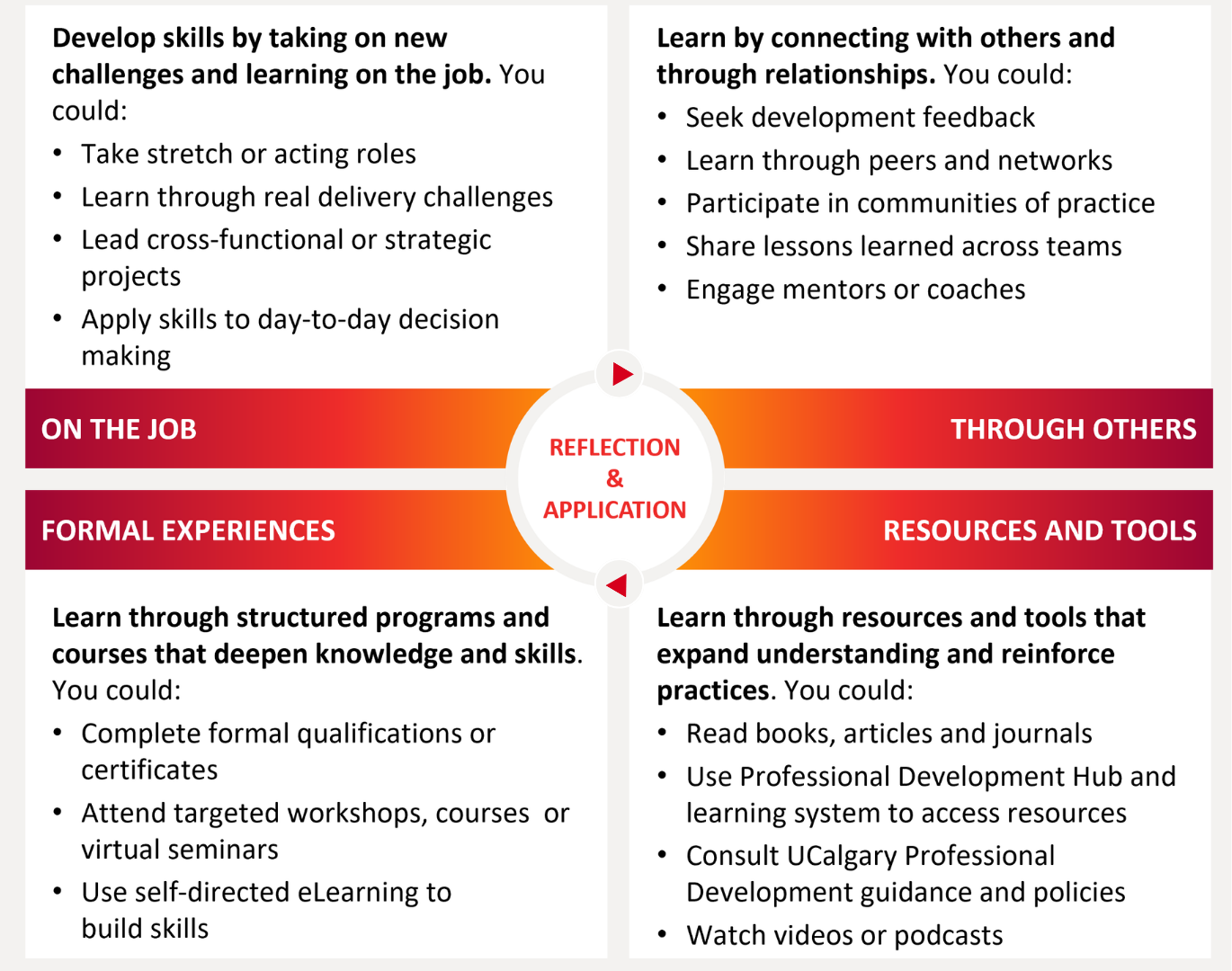
Continuous Learning Model
As a Postdoctoral Scholar, your learning is shaped by the research you advance, the skills you refine, and the academic and professional communities you engage with over time. Growth does not happen separately from your research, teaching, mentorship and career exploration, it happens through them.
The UCalgary Continuous Learning Model recognizes that development happens in four connected ways: In Your Role, Through Others, Formal Experiences, and Resources & Tools and with Personal Reflection and Application at the core. This reflects how postdoctoral capability is built: through hands-on research experience, collaboration and mentorship, intentional skill development, and thoughtful use of resources to support diverse career pathways within and beyond academia.
Your Individual Development Plan (IDP) can be used to clarify goals, track progress, and support meaningful conversations with supervisors and mentors about your professional development. It is a flexible tool designed to support your growth and career aspirations and not a performance evaluation.
This journey helps you to:
- Identify and prioritise development goals aligned with your evolving career path
- Use research, teaching, and service opportunities as platforms for skill-building and exploration
- Learn from supervisors, peers, and broader professional networks
- Engage in formal learning that strengthens research, transferrable skills, and career readiness
- Reflect on growth and document progress over time using your IDP

Build capability through the work postdoctoral scholars do every day
- You are building confidence as an independent researcher, educator, or scholarly professional
- Your research, teaching, mentoring, or leadership responsibilities are expanding
- You are preparing for future career opportunities within or beyond academia
- Learning occurs through meaningful work rather than separate development activities
- You have opportunities to take ownership, make decisions, and reflect on outcomes
- Workload or research demands are already unsustainably high
- Expectations, priorities, or responsibilities are unclear
- Stretch opportunities are added without adjusting other commitments
- Reflection and feedback are missing from day-to-day work
-
Light lift (low risk, easy to sustain)
- Lead a lab meeting, journal discussion, or project update
- Take ownership of a recurring process or workflow
- Mentor a graduate or undergraduate student
- Develop recommendations before seeking supervisor input
- Participate in grant preparation or manuscript development
-
Medium lift (visible growth, some support helpful)
- Lead a small research initiative or collaboration
- Develop teaching materials or learning activities
- Manage project timelines or research coordination activities
- Contribute to interdisciplinary or cross-faculty work
- Take responsibility for a new area of scholarly work
-
High lift (significant growth, workload adjustments may be needed)
- Lead major collaborations or complex research activities
- Supervise students or staff responsibilities
- Represent research teams in institutional initiatives
- Lead projects with uncertainty, evolving priorities, or multiple stakeholders
- What challenged me most in my research or role this week?
- What assumptions did I test or change?
- What would I do differently next time?
- How is this shaping my approach to my career path?
Supervisors and research leaders support learning by intentionally shaping responsibility and growth opportunities.
Effective support includes:
- Matching stretch opportunities to readiness and development goals
- Clarifying expectations, authority, and priorities
- Creating opportunities for increasing scholarly independence
- Providing feedback that strengthens confidence and judgement
- Supporting reflection—not only outcomes
Small moments of reflection help experience become learning.

Learn and grow through academic relationships and communities
- You are navigating uncertain research, career decisions, or transitions
- You want to learn how to approach problems, not just solve them
- You are developing professional identity, network, and confidence
- Insight is drawn from multiple perspectives beyond your lab or discipline
- Relationships remain informal without clear learning goals
- Feedback is received but not applied
- Networking becomes transactional rather than developmental
- Access to opportunities depends only on existing relationships
-
Light lift (low risk, easy to sustain)
- Ask peers how they approached challenges or decisions
- Observe meetings, presentations, or discussions outside your immediate work
- Seek perspective from colleagues across disciplines
- Discuss career pathways with researchers or professionals
-
Medium lift (visible growth, some support helpful)
- Participate in mentoring relationships with clear development goals
- Join communities of practice or professional networks
- Seek feedback from supervisors, collaborators, or teaching partners
- Build relationships outside your immediate research area
-
High lift (significant growth, workload considerations may be needed)
- Mentor graduate students or peers
- Co-lead collaborative initiatives
- Represent your team, department, or discipline in broader initiatives
- Build external professional networks aligned to future career goals
- What new perspective did I gain?
- Which assumptions were challenged?
- How will I apply this insight?
- What would I do differently next time?
Leaders support learning through others by creating opportunities for purposeful connection.
Effective support includes:
- Encouraging mentoring and peer learning
- Supporting participation in communities and networks
- Connecting people across disciplines and perspectives
- Encouraging feedback-seeking and dialogue
- Creating equitable access to learning relationships and opportunities
- Mentoring at UCalgary
- The Mentorship Guide for Teaching and Learning
- Resilience Community of Practice | Office of Institutional Commitments – CMHWB
- Building Your Professional Network | LinkedIn Learning
- One-on-One Support |Taylor Institute for Teaching and Learning
- Teaching Support | Libraries and Cultural Resources
- Postdocs at UCalgary

Build knowledge and skills through structured learning opportunities
- You are building capability for research, teaching, leadership, or career development
- Complex topics benefit from structured instruction
- Credentials or formal learning strengthen effectiveness or future opportunities
- Learning can be applied soon after participation
- There is no clear purpose or application
- Learning is not applied soon after
- Time constraints prevent meaningful engagement
-
Light lift (low risk, easy to integrate)
- Attend workshops aligned to current priorities
- Complete short self-directed learning modules
- Participate in targeted skill development sessions
-
Medium lift (visible growth, feedback helpful)
- Participate in structured learning pathways
- Attend conferences with clear learning goals
- Complete certificates aligned to future career interests
-
High lift (significant growth, clear boundaries required)
- Complete academic courses or extended programs
- Pursue formal credentials
- Participate in cohort-based development opportunities
- What concepts are most relevant to my work?
- What will I apply, adapt, or stop doing?
- How does this influence my research, teaching, or career direction?
Leaders strengthen formal learning by helping connect learning back to practice.
Effective support includes:
- Helping clarify development priorities
- Creating space to apply learning
- Encouraging reflection and experimentation
- Supporting learning aligned to future goals
- Valuing capability growth—not only completion
The Taylor Institute for Teaching and Learning
- Taylor Institute Courses, Workshops and Events
- Taylor Institute Learning Modules
- Postdoctoral Scholar and Graduate Student Certificates in University Teaching and Learning
Leadership and professional capability

Strengthen practice through on-demand support
- Resources directly support research, teaching, leadership, or career planning
- Tools reduce uncertainty and improve efficiency
- Learning can be immediately applied
- Resources support current work or future development goals
- Resources are collected but not used
- Too many tools create overload
- Reading replaces doing
-
Light lift (low risk, easy to integrate)
- Use templates, guides, and toolkits while completing work
- Access learning resources to strengthen specific skills
-
Medium lift (visible growth, feedback helpful)
- Apply resources across multiple contexts
- Build systems and practices that improve efficiency
-
High lift (significant growth, clear boundaries required)
- Curate resources for peers or trainees
- Contribute to improving shared resources and knowledge
- How did this resource influence my decisions?
- Where did it help or fall short?
- What will I do differently next time?
Leaders support resource-based learning by normalizing and modelling resource use.
Effective support includes:
- Pointing people toward trusted resources
- Supporting just-in-time learning
- Reinforcing that seeking information is part of strong practice
- Ensuring resources remain visible and accessible
Research and institutional resources
Career development
- Career Planning
- Outreach Career Development Library
- How to Write a Winning Résumé
- How to Prepare for an Interview
LinkedIn Learning Course Libraries

Upcoming Learning Opportunities
View upcoming learning experiences to help enhance your professional development and connect with colleagues across campus.