
Individual Contributor
Strengthening capability, confidence and career growth.
Learning and growing as an individual contributor
As an individual contributor, you are the owner of your learning and development. Your impact comes from how you build capability over time, through the work you do, how you learn with others, the learning you choose and the resources you actively use.
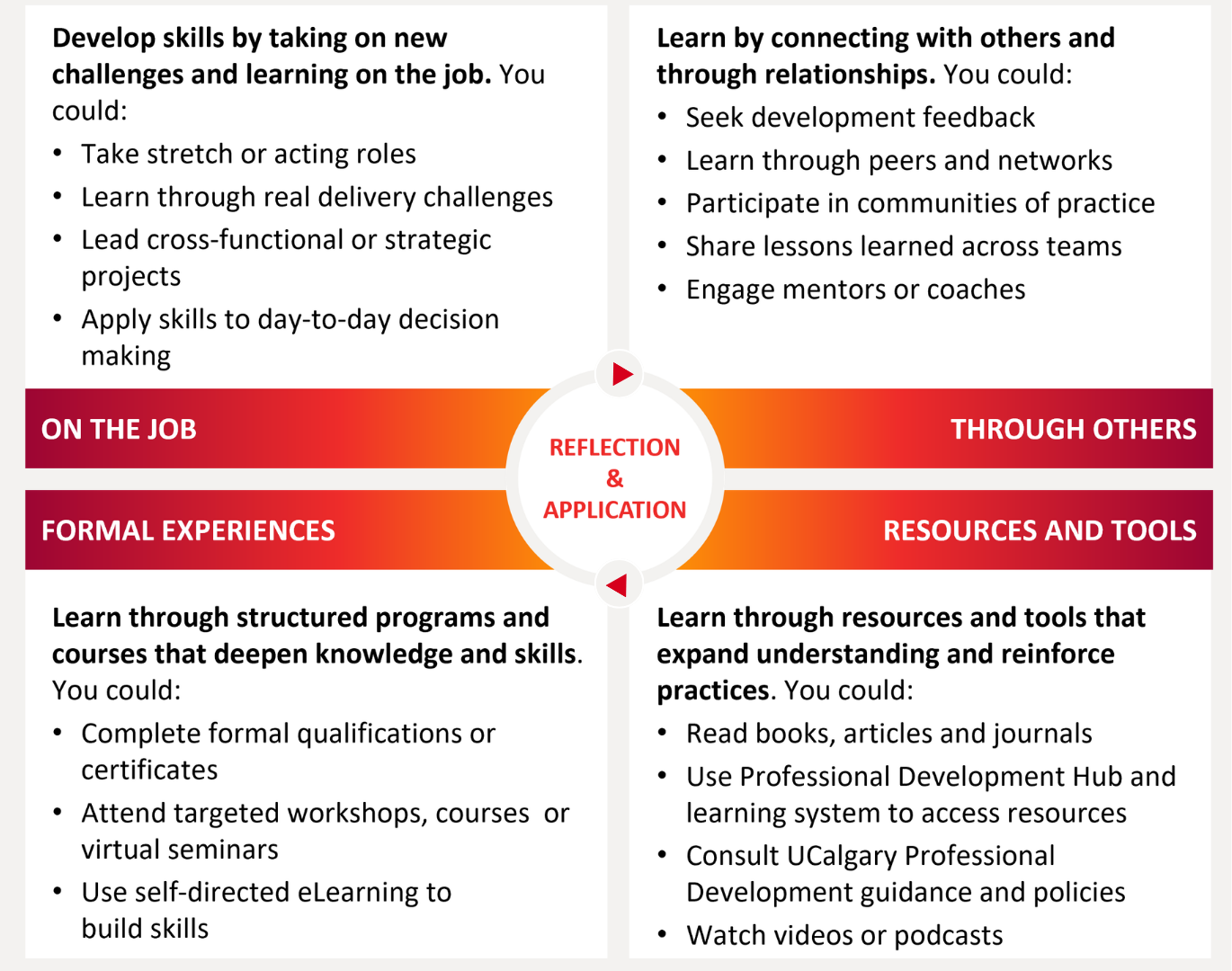
The UCalgary Continuous Learning Model recognizes that learning happens in four complementary ways: In Your Role, Through Others, Formal Experiences, and Resources & Tools and with Personal Reflection and Application at the core.
This journey helps you:
- Decide where to focus your learning now
- Use everyday work as a development opportunity
- Partner effectively with your leader
- Capture and reflect on growth using your Individual Development Plan (IDP)
How do I develop as an individual contributor?
Learning happens in different ways: through your work, your relationships, structured programs and on‑demand resources. Start by choosing the approach that best fits your current goals.

Grow capability through the work you already do
Learning grows capability through real work—not by adding extra learning—and is most effective when stretch is intentional, time‑bound, and supported.
It works best when:
- Stretch is purposeful and manageable (challenging, but not overwhelming)
- Expectations and outcomes are clear so effort is focused on learning, not figuring things out
- Support and feedback are available to guide progress and adjust in real time
- There is space to reflect and apply learning so experience turns into improved performance
- You’re focusing only on delivery instead of learning
- You’re unclear on expectations or next steps
- You’re taking on too much stretch at once
-
Light lift (low risk, easy to integrate)
- Take ownership of a recurring decision
- Lead a meeting or agenda item for a defined period
- Represent your team in a cross‑functional conversation
- Move from executing tasks to designing options or recommendations
-
Medium lift (visible growth, feedback helpful)
- Own a piece of work end‑to‑end (not just execution)
- Lead a small project or improvement initiative
- Assume accountability for a new client / customer or collaborate across teams
- Work through ambiguity before escalating (bring options, not just problems)
-
High lift (significant growth, clear boundaries required)
- Lead a complex or high‑impact project
- Take on a temporary stretch assignment or expanded scope
- Work on problems with unclear direction or competing priorities
- Represent the team/unit in broader or institutional work
Short reflection helps turn experience into learning. After periods of stretch, consider:
- Where could I take more ownership to learn—without overloading myself?
- What felt most challenging, and why?
- What assumptions did I test or adjust?
- What would I do differently next time?
Even five minutes of reflection reinforces development.
Learning works best as a shared responsibility between individual contributors and leaders.
Leaders support development by shaping work thoughtfully, including:
- Clarifying expectations and decision boundaries
- Rebalancing workload during periods of stretch
- Encouraging learning through responsibility—not perfection
- Creating space for short, regular reflection and feedback
When expectations, boundaries, and support are actively managed, learning becomes part of the work—not an extra add‑on.

Learn through relationships, perspective, and feedback
Learning through others is most effective when relationships are used intentionally for development, not just connection.
Learning through others works best when:
- You are navigating new or unfamiliar situations
- You want perspective, insight, or feedback
- Learning includes active dialogue and reflection
- Relationships are purposeful and linked to your development goals
- Insights are applied back into your work in ambiguous or unfamiliar situations.
Use this approach with care when:
- Conversations lack a clear learning purpose
- Feedback is gathered but not reflected on
- Networking becomes passive rather than developmental
- Learning relies on only familiar perspectives
- Expectations within mentoring relationships are unclear
Connection becomes learning when insight leads to action.
-
Light lift (low risk, easy to integrate)
- Ask colleagues how they approached a challenge and why
- Observe meetings or projects outside your regular context
- Seek informal feedback from peers or collaborators
-
Medium lift (intentional development)
- Join a mentoring relationship with clear goals
- Participate in communities of practice
- Engage in peer learning or collaborative problem‑solving
-
High lift (significant growth, requires boundaries)
- Co‑lead projects or initiatives
- Mentor others to strengthen your own thinking
- Represent your team or unit in broader initiatives
After learning through others, pause to consider:
- Whose perspective could help me think differently?
- What feedback have I avoided or overlooked?
- Which relationships are helping me grow right now?
- Where could I contribute more actively to shared learning?
- What insight can I apply immediately in my work?
Short reflection turns conversation into development.
Leaders support learning through others by:
- Encouraging mentoring and peer learning
- Creating access to diverse networks and perspectives
- Normalizing feedback and reflection
- Supporting collaborative learning opportunities
-
Mentorship & Connection
- Finding a Mentor at UCalgary (Document)
- Mentoring at UCalgary (Document)
- UCalgary Alumni Mentorship (MentorLINC)
- Being a Good Mentor (LinkedIn Learning)
- Building a Mentorship Plan (LinkedIn Learning)

Build knowledge and skills through structured learning
Formal learning is most effective when it is chosen deliberately and applied intentionally.
Formal learning works best when:
- Learning aligns to your current role or future goals
- New skills are applied soon after learning
- Learning includes reflection and practice
- Time and capacity exist to engage meaningfully
- A specific capability need is clearly identified
Use this approach with care when:
- Courses are taken without a clear purpose
- Learning is completed but never applied
- Too many learning priorities compete at once
- Credentials become the goal instead of capability growth
- Development is disconnected from everyday work
Learning creates value through application—not accumulation.
-
Light lift (low risk, easy to sustain)
- Complete short LinkedIn Learning modules
- Attend workshops connected to current work
- Explore targeted professional development resources
-
Medium lift (visible growth, some leader support needed)
- Participate in multi‑session learning programmes
- Attend conferences or professional events
- Complete courses that deepen workplace capability
-
High lift (significant growth, rebalance workload)
- Pursue certificates or credentials
- Commit to extended cohort‑based programmes
- Complete academic or Continuing Education programmes
Before or after formal learning, ask:
- What capability am I trying to build right now?
- Where will this learning show up in my work?
- What learning should I prioritize over the next six months?
- What have I learned recently that I have not yet applied?
- How does this learning connect to my longer‑term goals?
Leaders support formal learning by:
- Helping clarify development priorities
- Supporting realistic learning timelines
- Creating opportunities to apply learning
- Encouraging sharing and knowledge transfer
- Valuing growth and application—not just completion
-
Career and Professional Development
- Career Development Course Library (LinkedIn Learning)
- Career Resources by UCalgary Alumni
- Know Yourself | Alberta ALIS
- Developing Your Professional Image in a New Job (LinkedIn Learning)
- Self Leadership (Workshop)
-
Communication, Thinking and Workplace Skills
- Connect to Perform Learning Series (Online Course)
- Navigating Challenging Conversations (Workshop)
- The Art of Giving & Receiving Feedback (Workshop)
- Writing and Editing Skills in the Workplace (Continuing Education Program)
- Creating Safe Spaces for Tough Conversations at Work (LinkedIn Learning)
- Communication (LinkedIn Learning)
- Critical Thinking for Better Judgement and Decision-Making (LinkedIn Learning)
- Strategic Thinking (LinkedIn Learning)
- Time Management Fundamentals (LinkedIn Learning)
- Getting Things Done (LinkedIn Learning)
- Problem-Solving Techniques (LinkedIn Learning)
- Learning from Failure (LinkedIn Learning)
-
Leadership and Continuing Education
-
Indigenous Learning & Workplace Culture
- Beginning the Journey Towards Reconciliation (Online Course)
- The Story of ii’ taa’poh’to’p (Online Course)
- Health & Wellness in the Workplace (Workshop)
- The Working Mind – Employee Workshop (Workshop)
- Enhancing a Culture of Respect in the Workplace (Workshop)

Learn in the flow of work
Resources and tools are most effective when they support learning at the point of need.
Learning through resources works best when:
- Tools are used during real work
- Learning connects directly to tasks and decisions
- Tools reduce uncertainty or cognitive load
- Resources are easy to access and apply
- Reflection and experimentation happen alongside use
-
Light lift
- Use checklists or templates while completing tasks
- Reference policies during decisions
- Watch short learning content tied to current work
-
Medium lift
- Use the same tool across multiple situations
- Adapt a template and reflect on outcomes
- Share tools with peers and compare use
-
High lift
- Help improve shared tools
- Turn informal practices into job aids
- Curate resources for others
After using a resource or tool, consider:
- What tools help me work more effectively?
- What resource do I rely on regularly?
- What process still feels unclear or inefficient?
- What tool or template could I improve?
- What learning resource supports my current priorities?
Leaders support learning through tools by:
- Modelling use of resources themselves
- Making tools visible and accessible
- Encouraging application over consumption
- Reinforcing judgment over rigid use
Development and Career Planning Tools
- Individual Development Plan (IDP)
- Professional Development Hub Resources Library (University of Calgary)
- Preparing for a Leadership Role (PDF)
Learning and Tuition Support
LinkedIn Learning
- Log in to UCalgary’s LinkedIn Learning using single sign‑on.
- Optionally connect your LinkedIn profile to receive personalized recommendations and display completed courses by selecting Me > Settings > Connect LinkedIn (LinkedIn login required).
- Set your learning preferences by choosing topics like business, creative or technology skills.
- Once set up, explore recommended courses, search by topic, and start learning anytime, anywhere.
- Log In Here
Your Individual Development Plan (IDP) is the primary tool to support your learning ownership.
-
The IDP helps you
- Clarify development priorities
- Identify learning through work, people, and formal experiences
- Reflect on growth over time
- Support meaningful development conversations with your leader
-
The IDP is
- Employee‑owned
- Flexible and evolving
- Focused on development—not performance evaluation
Tip: Focus on 1–2 priorities for the next six months. Revisit every few months and adjust as your role or goals change.

Upcoming Learning Opportunities
View upcoming learning experiences to help enhance your professional development and connect with colleagues across campus.