-
- Super-jet Provides New Challenges For Airports
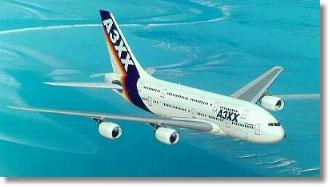
U of C researchers studying the compatibility of airports and the new 555-seat A3XX jet.
Researchers at the University of Calgary are among only a handful of scientists worldwide and are the only ones in Canada looking for solutions to the challenges posed by the introduction of Airbus Industries' 555-seat commercial super jet.
The company recently announced it is ready to begin production of the double-decker jet and anticipates the A3XX will be ready for commercial flights by 2006.
With most large airports already congested and air traffic forecasted to double within the next 15 years, the introduction of a larger-capacity aircraft such as the A3XX comes as a solution to this increased air traffic without increasing congestion. According to U of C professor of engineering, Dr Chan Wirasinghe, however, the introduction of a larger capacity aircraft also brings with it a range of new challenges to the aviation industry. Existing airports were designed to accommodate the Boeing 747, currently the largest civil passenger aircraft in operation. The 747 carries just over 400 passengers.
"The A3XX will be longer, wider, and taller than the Boeing 747, and will be able to carry 50 per cent more passengers," says Dr Wirasinghe. "As a passenger this new technology may translate into increased congestion in departure lounges, swarms of individuals fighting to quickly collect their luggage and longer boarding line-ups.
"How will the aircraft fit on runways, taxiways and aprons that were designed for the 747?" he asks. "How will the passenger terminals cope with the increase in passengers it will have to process? How should new airport developments be planned to take the A3XX into consideration?" A new study led by Dr Wirasinghe - the first of its kind in Canada - will address issues such as the optimum number of gates to serve the new aircraft, the best terminal configuration, the design and size of the gate lounge and of the baggage claim area, and the methods used to improve passenger processing.
"This new aircraft may revolutionize the flying experience, but we hope the findings from our study will help ensure the experience is quick, easy and smooth," he says.
For further information, please contact:
Dr. Chan Wirasinghe, Professor of Civil Engineering,
- Phone:+1 403 220-7180
Fax: +1 403 282-7026
E-mail: wirasing@ucalgary.ca
Alexandre de Barros, PhD Candidate,
- Phone: +1 403 220-4813
Fax: +1 403 282-7026
E-mail: agdbarro@ucalgary.ca
-

- Department of Civil Engineering
- 2500 University Drive NW
- Calgary, Alberta
- CANADA T2N 1N4
- 2500 University Drive NW
- NLA HomePage
Transportation Engineering | Department of Civil Engineering | Schulich School of Engineering | The University of Calgary
- Department of Civil Engineering