A Constant State of Becoming:
The competition brief called for an urban design strategy for the block of
land south of the parliament, that somehow engaged the notion of an identity
or characteristic that is of or about Canada. Our response discusses the
continuous state of becoming that is inherent in the art, the architecture,
and the urban ambitions of such a rich and sparsely populated country. The
project is about the potential of our art, and how these potentials reflect
our identity.
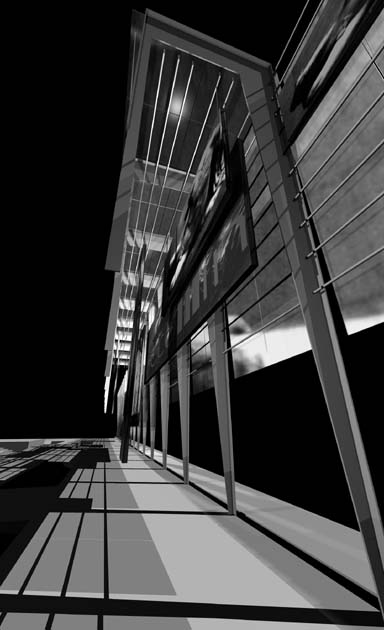
The site is defined on the north side by a steel datum that serves as a massive, grounded ordering device. The steel datum supports an armature that is the scale element by which the intervention permits the connection of vertical and horizontal planar devices, stage platforms, lighting/projection systems, glass, material, wrap.
The armature allows programmed performance or gallery space, open to the elements or in sealed, suspended rooms, for small artifacts or very large objects. Initially, the structure must be engaged by those who wish to use it as a means for artistic expression. Such primary engagement may involve the use of the structure simply as scaffold for the display and interaction with art objects. Such involvement with an open-ended system can also generate an interaction between art and architecture;
...further to conceive of a two-way commerce between scaffold and object, 'structure' and 'event', between the fabric of the museum and its contents, a commerce in which both components retain an identity enriched by intercourse, in which their respective roles are continuously transposed, in which the focus of illusion is in constant fluctuation with the axis of reality.
The architecture is understood as it is programmatically engaged; it erases itself, except in memory, when the performance, exhibition, or installation closes. The enrichment of the cultural, collective memory is the potential of this urban architecture. It is never completely realized, nor is it forgotten.
The system is conceptually infinite. It can expand east and west along Wellington Street, engaging the city as site conditions allow. Here the second form of engagement begins, that involving the perceptual and interactive experience of art. The scale and the siting of the structure allow for exhibited work to be viewed from many vantage points. The act of movement along Wellington Street, either as a pedestrian or by automobile in the case of a visiting dignitary travelling Ottawa's ceremonial route, results in a scenographic series of events that animate and inform the urban experience.
The structure creates a dramatic edge to the federal Parliament Buildings and Commons, the main public space for the city and the nation. Moments of repose and reflection can be found through direct encounter with the structure from the sidewalk. As well, a space for performance is provided by the newly formed amphitheater, utilizing the urban sidewalk as a stage and the new structure as fly tower. From this vantage point, the structure and exhibits together provide a physical and visual lens filtering and informing one's view of the nation's Peace Tower.